In the south-eastern corner of the country, south of Chimanimani and out of the woods, is a region of baobabs, scrublands and sandstone cliffs.
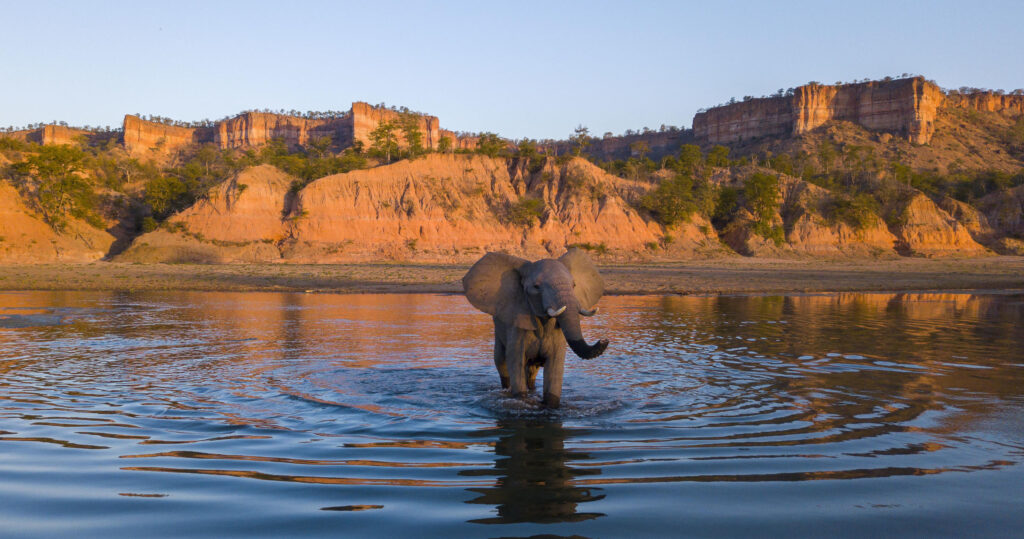
The Chilojo Cliffs are visible for 50 km and daybreak and sunset soak the rocks in coloured light and silhouette the baobabs. This distinctive ‘upside down tree’ with its root-like branches seems, like the ostrich, to have its head in the sand. According to legend that’s the price the baobab paid for offending the gods.
Gonarezhou is Zimbabwe’s second largest game reserve (after Hwange), and its 5,053km2 border Mozambique’s wildlife reserves and South Africa’s Kruger National Park. Animals, of course, know no boundaries and they move freely between the three sanctuaries.
The Mwenezi, Save and Runde rivers wind through the hot, semi-arid lowveld and support the rare suni antelope and striped king cheetah as well as some of the biggest and meanest elephants in the country. Aptly, Gonarezhou means “place of elephants” in Shona and in 1967, the same year that the park was created, an elephant was killed on its perimeter. Its tusks weighed in at 62 kg and 48 kg. The elephant was discovered to be the son of the equally unfortunate Dhlulamithi (taller than trees).
The infamous poacher, Stephanus Barnard, had bagged big daddy in the 1920’s and his tusks tipped the scale at a total of 110kg. In later years during the bush war, along with much of the eastern border, this was a no-go area and elephants were hunted by guerrillas and poachers as well as being devastated by drought.
However, when the park was opened again in 1994, elephant numbers had not declined. Rather, an excess 750 had to be relocated that same year. These great beasts are understandably shyer here than anywhere else in the country and are not fond of humans so keep a safe distance.
The park is divided into two regions: The Save/Runde area in the north and Mwenezi in the south and is open from May to October. During the summer rainy season, access is more limited. 4×4 vehicles are required year-round and accommodation runs only to camp sites. There are a number of luxury lodges outside the park.